
The Port of Rotterdam has long been the beating heart of European trade, a colossal engine of logistics where millions of containers act as the red blood cells of the continental economy. Yet, for the past decade, this heart has been skipping beats. A “perfect storm” of chronic labor shortages, skyrocketing energy prices, and diminishing industrial space has threatened to choke the efficiency of the region. Today, a new player named Stockwell has officially launched a solution that promises not just to unclog the arteries of trade, but to replace the old veins entirely with something faster, cleaner, and radically cheaper.
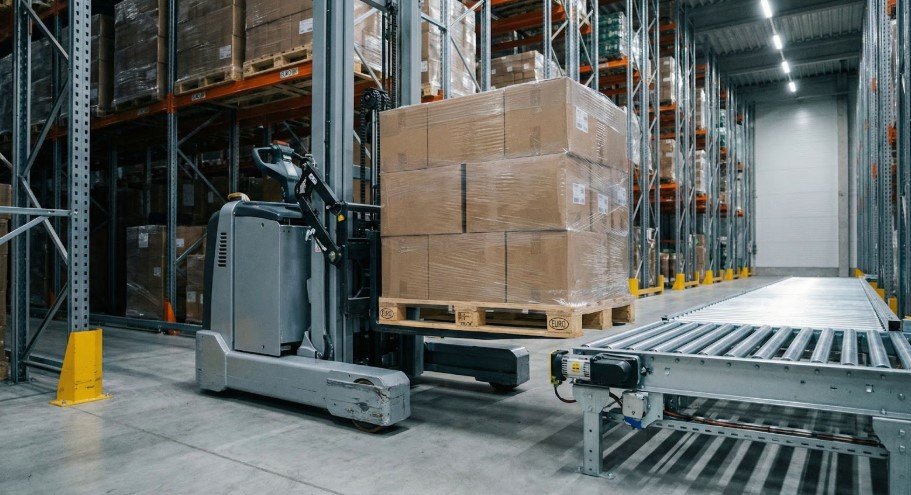
Stockwell’s arrival marks the debut of the region’s first fully automated, robotic “dark warehouse” dedicated to pallet storage in Rotterdam. It is a facility that looks less like a traditional warehouse and more like a data center for physical goods. Inside, there are no break rooms, no pedestrian walkways, and most strikingly—no lights. In this pitch-black environment, a fleet of Autonomous Mobile Robots (AMRs) glides in silence, managing inventory 24 hours a day, 7 days a week, without a single human hand touching a pallet.
The End of the Labor Crisis
To understand why Stockwell’s launch is shaking the foundations of the Dutch logistics sector, one must first look at the numbers. According to recent industry reports, the Netherlands is facing a historic deficit of logistics personnel. Forklift drivers, warehouse managers, and pickers are in short supply, driving wages up and reliability down. For business owners, this has created a nightmare scenario: having product ready to sell but no one to move it.
“The traditional warehousing model is broken because it is too dependent on a workforce that simply isn’t there anymore,” explains the CEO of Stockwell during the facility’s opening ceremony. “We realized that trying to recruit our way out of this crisis was futile. The solution wasn’t more people; it was better technology. By building a facility that requires no human labor for the storage and retrieval process, we have inoculated our clients against labor shortages. Our robots don’t get sick, they don’t strike, and they don’t need sleep.”
This reliability is the first pillar of the Stockwell promise. For supply chain managers tired of the volatility of human staffing, the “dark warehouse” offers a flat-line of consistency. Whether it is Christmas Eve or a Tuesday morning, the capacity of the Stockwell facility remains exactly the same.
The 25% Cost Revolution
While reliability is attractive, the strongest argument for Stockwell is undoubtedly financial. In a traditional warehouse, the cost of labor can account for up to 65% of the total operating budget. When you factor in the cost of lighting a 50,000-square-meter facility, heating it to a comfortable temperature for workers, and insuring those workers against injury, the overheads are staggering.
Stockwell has effectively deleted these costs.
No Lighting: The robots navigate using sensors and LIDAR, meaning the facility operates in total darkness, slashing electricity bills.
No Heating: Unless specific goods require temperature control, the facility does not need to be heated for human comfort.
No Payroll: The primary workforce is capital assets (robots), not salaried employees.
“We have taken the most expensive line items on a P&L sheet and removed them,” the CEO continues. “And we are not keeping those savings as extra margin. We are passing them directly to the customer. We are proud to announce that our storage rates are, on average, 25% cheaper than any manual competitor in the Rotterdam area.”
For a mid-sized import business holding 2,000 pallets, a 25% reduction in storage fees can mean the difference between a profitable year and a break-even one. In an era where inflation is eating into margins from every side, Stockwell’s deflationary pricing model is a rare lifeline.
Maximizing Rotterdam’s Scarcest Resource: Space
The innovation extends beyond just robots. It changes the very architecture of storage. In a manual warehouse, valuable square footage is wasted on wide aisles to allow forklifts to turn and maneuver. Safety regulations require separate pathways for pedestrians.
Stockwell’s automated warehouse ignores these human limitations. The robots run on a high-density grid, allowing pallets to be stored closer together and stacked higher than would be safe for human operators. This “vertical density” means Stockwell can store 40% more goods in the same footprint as a traditional warehouse. In a city like Rotterdam, where industrial land is scarce and expensive, this efficiency is critical.
A Green Leap Forward
Finally, the “dark warehouse” is also a green warehouse. The massive reduction in energy consumption aligns perfectly with the EU’s aggressive carbon reduction targets. Companies looking to improve their ESG (Environmental, Social, and Governance) scores can now do so simply by switching their storage provider.
Stockwell is not just a new warehouse; it is a glimpse into the future of logistics. It is a future where the supply chain is silent, invisible, efficient, and significantly more affordable. For the business owners of Rotterdam, the lights may be out at Stockwell, but the future has never looked brighter.
Ready to future-proof your supply chain? Visit stockwellbv.com today to book a virtual tour and secure your space.
